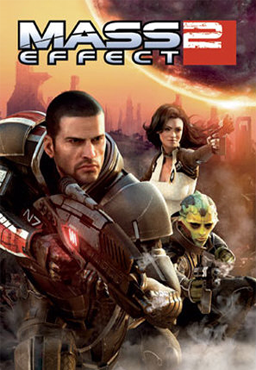
If Dragon Age: Origins was the game that got me to re-think my stance on Bioware, and the original Mass Effect was the game that finally tipped me over the edge to being a full-fledged Bioware fanboy, then Mass Effect 2 is the game that makes me glad to be there. It picked up where its predecessor left off, did a bunch more things right (and ME did plenty right on its own), and resulted in perhaps the best hybrid RPG ever.
Fans of the original, and of RPGs in general, will immediately notice that ME2 is less RPG-y than the original and than most of Bioware's earlier RPGs. The inventory system was one of the few weaknesses in the original; at times, it felt more like we were playing Spreadsheet: The RPG. Of course, whether to use Incendiary Ammo VII or Cryogenic Ammo VI would probably make such a slight sliver of difference to the gameplay that you'd really have to be looking for it to notice it, but let's face it: I spent far too long optimizing everyone's ammo upgrades on their tertiary weapons, and you did too.
ME2 doesn't waste time with those details. Every character has a handful of weapons, of which they'll ever use two at the most. Shepard's armor is customizable, but in a "hey, that's a cool bonus" sort of way as opposed to "I must squeeze every possible point of defense out of this." And gone are the multitude of skills that you may or may not ever use; each character has three plus a bonus that's unlockable over the course of the game. The result is something that doesn't feel exactly like an RPG, certainly less so than the first game did, but then again doesn't really sell itself as one or claim to be one.
All of those simplifications are things that could make the RPG purist whine, and fair enough to that. (We still have the RPG-tastic Elder Scrolls series--and Bioware's own Dragon Age--to console us.) But look at the other side of the coin: think of the pain that shooter purists must be feeling! There's no barrel-aim acceleration, no "realistic" obstacles to hitting your target like your character's breathing or footsteps, and no fancy scopes or aiming reticules. But as much as each of those is a sine qua non to a shooter person, they just represent inaccessibility to the rest of us.
So Mass Effect 2 manages to do something that's very rare indeed in the realm of game design: it hybridizes two genres to the satisfactions of all parties. It strips down both genres and figures out what's fundamentally fun about each with little regard for attaching either side's sacred-cow strictures. Then it combines all that fun into a game that turns out to be... fun.
The other thing that Mass Effect 2 does remarkably well is stray from the Bioware Path. The in media res prologue is still there, and so is the climactic final "dungeon", but gone is the almost amusingly tried-and-true "here are four parallel tasks that you must accomplish and which take place in different corners of the world" formula that literally every other Bioware game has followed. ME2 is stronger for pursuing its own identity. There's no artificial unfolding of the plot and very little railroading; instead, the endgame is laid out plainly after only a few hours of gameplay, and you can choose whichever path you see fit to get there.
It's a trend in modern video gaming to make games a reflection of a story that you want to tell rather than what the developers want to tell, and no game out there accomplishes this better than ME2. Although every playthrough of the game ends up in the same place, it's entirely up to you to get there, and your version of the game is the result of dozens of decisions that you make. It's an engaging and ultimately more rewarding experience than playing through someone else's version of the game.
And it's that immersive storytelling that really sets Bioware apart from other game studios. Bethesda builds worlds and lore better. Nintendo is more prolific and has a virtual monopoly on classic franchises. But if Bioware can make their trilogy's middle volume one of the best games in years, then consider me a fan.
Currently listening: The Valley, Eisley (review to follow!)
Showing posts with label Bioware. Show all posts
Monday, February 28, 2011
Saturday, September 04, 2010
Mass Effect: Debrief
It's true: it's taken me until now to play through Mass Effect. Yes, it's been around for more than two years--in fact, I think I got some sort of second anniversary discount when I bought it back in May. Yes, a veritable legion of my friends has tried to convince me to play it for those last two years--and friends whose video game opinions I generally respect. Yes, I pretty much adore Dragon Age: Origins--and in the grand Bioware tradition, Dragon Age is basically just Mass Effect dressed up as fantasy.
I don't know why it's taken me so long. Part of it was probably my lack of time over the last two years; part of it was that I anticipated the game having too much shooter influence for my tastes--even though shooters are de rigueur in video gaming these days, I haven't played one I really got into since Perfect Dark back in 2000. Of course, my friends were completely right on this one. Mass Effect is a very good video game.
I've argued before that every Bioware game plays the same, and Mass Effect is no exception. It follows the now-familiar structure: a short in media res prologue that gets the action going; Act 1, which takes place in some beacon of civilization, establishes the central conflict of the game, and builds your party; a massive Act 2 that occupies the majority of the game and features four parallel main quests in the far reaches of the setting; a climactic Act 3, which features some major plot revelations and sets up the final battle; and a short Act 4, which is basically the final battle with a short lead-up. There are lots of side assignments you can do, many of which involve your characters and getting to know their stories better--including some that lead to romance subplots.
At around 35 hours, Mass Effect is a little shorter than I expected it to be. Maybe that shows the background that I game from--I grew up on JRPGs like Chrono Trigger and the Final Fantasy series that, even back in 1995, routinely lasted for 50-60 hours. I sunk 110 hours into Final Fantasy X, 120 into Oblivion, and I don't even want to know how many (but probably at least 150) into Morrowind. I didn't explore every nook of every isolated planet to find every side quest in the game, but I did put reasonable effort into finishing all the ones I bumped into. You could probably stretch Mass Effect to 40-45 hours if you dragged a fine-toothed comb over it, or you could probably speed through it in as few as 20-25.
But that would be a mistake. Bioware might come across as the poor man's Bethesda when it comes to crafting open, dynamic, and explorable worlds, but they're still far and away better at it than virtually everyone else in the business. There's a lot going on in Mass Effect, between history, setting, and characters, and it's worth it to explore as much of it as is feasible.
Mass Effect doesn't suffer from nearly as many difficulty issues as would plague Dragon Age: Origins just a year later. Both games scale their difficulty, so that your enemies get tougher as you do--except that the only thing that happens to your enemies is that the numbers go up. As you become more powerful, it's not strictly about the numbers, it's also about the additional things you can do. My mage character in Dragon Age was very much tilted toward "things" rather than "numbers," so the beginning of the game was unreasonably difficult (I would routinely die to a wolf ambush), while the end was almost trivially easy (because of all the resources at my disposal, I never felt seriously threatened by the final boss).
It might be a different approach to the character that I took in Mass Effect that made the difficulty more even throughout, or it might be that Mass Effect is just balanced better. Either way, the difficulty is appropriate at virtually every stage of the game, and I definitely felt seriously threatened by the final boss here.
Aesthetically, the game is decent to good. The music is passable, but it's no Jeremy Soule soundtrack (a la the Elder Scrolls games). As for the graphics, I turned the resolution up to 1280x1024 and all the other settings squarely to "medium," and I think it struck a nice balance of looks and performance, at least on my system. (My computer is only about a year old, and relatively powerful--but by no means a gaming rig. If you have a machine legitimately built for gaming, you'll be able to crank all the settings up with no problem.)
The controls are reasonably intuitive and mostly explained over the course of the "prologue" act, with a the exceptions of a handful of the minigames and a couple vagaries of the Mako tank. (In fact, there are plenty of vagaries of the Mako tank.)
But what you're really playing this game for is the story, which is executed brilliantly. It unfolds entirely sensically from the prologue to the final act, and even though you're clearly dealing with some world- (or galaxy-) changing stuff, you never really feel overwhelmed or in over your head. The plot toes the line between a self-contained story with an exciting climax and satisfying resolution and a first installment of a trilogy that's obviously part of something much bigger than itself. It works on both levels, and the best sign of its success is how excited I am about playing Mass Effect 2.
Currently listening: "Somebody Told Me", the Killers
I don't know why it's taken me so long. Part of it was probably my lack of time over the last two years; part of it was that I anticipated the game having too much shooter influence for my tastes--even though shooters are de rigueur in video gaming these days, I haven't played one I really got into since Perfect Dark back in 2000. Of course, my friends were completely right on this one. Mass Effect is a very good video game.
I've argued before that every Bioware game plays the same, and Mass Effect is no exception. It follows the now-familiar structure: a short in media res prologue that gets the action going; Act 1, which takes place in some beacon of civilization, establishes the central conflict of the game, and builds your party; a massive Act 2 that occupies the majority of the game and features four parallel main quests in the far reaches of the setting; a climactic Act 3, which features some major plot revelations and sets up the final battle; and a short Act 4, which is basically the final battle with a short lead-up. There are lots of side assignments you can do, many of which involve your characters and getting to know their stories better--including some that lead to romance subplots.
At around 35 hours, Mass Effect is a little shorter than I expected it to be. Maybe that shows the background that I game from--I grew up on JRPGs like Chrono Trigger and the Final Fantasy series that, even back in 1995, routinely lasted for 50-60 hours. I sunk 110 hours into Final Fantasy X, 120 into Oblivion, and I don't even want to know how many (but probably at least 150) into Morrowind. I didn't explore every nook of every isolated planet to find every side quest in the game, but I did put reasonable effort into finishing all the ones I bumped into. You could probably stretch Mass Effect to 40-45 hours if you dragged a fine-toothed comb over it, or you could probably speed through it in as few as 20-25.
But that would be a mistake. Bioware might come across as the poor man's Bethesda when it comes to crafting open, dynamic, and explorable worlds, but they're still far and away better at it than virtually everyone else in the business. There's a lot going on in Mass Effect, between history, setting, and characters, and it's worth it to explore as much of it as is feasible.
Mass Effect doesn't suffer from nearly as many difficulty issues as would plague Dragon Age: Origins just a year later. Both games scale their difficulty, so that your enemies get tougher as you do--except that the only thing that happens to your enemies is that the numbers go up. As you become more powerful, it's not strictly about the numbers, it's also about the additional things you can do. My mage character in Dragon Age was very much tilted toward "things" rather than "numbers," so the beginning of the game was unreasonably difficult (I would routinely die to a wolf ambush), while the end was almost trivially easy (because of all the resources at my disposal, I never felt seriously threatened by the final boss).
It might be a different approach to the character that I took in Mass Effect that made the difficulty more even throughout, or it might be that Mass Effect is just balanced better. Either way, the difficulty is appropriate at virtually every stage of the game, and I definitely felt seriously threatened by the final boss here.
Aesthetically, the game is decent to good. The music is passable, but it's no Jeremy Soule soundtrack (a la the Elder Scrolls games). As for the graphics, I turned the resolution up to 1280x1024 and all the other settings squarely to "medium," and I think it struck a nice balance of looks and performance, at least on my system. (My computer is only about a year old, and relatively powerful--but by no means a gaming rig. If you have a machine legitimately built for gaming, you'll be able to crank all the settings up with no problem.)
The controls are reasonably intuitive and mostly explained over the course of the "prologue" act, with a the exceptions of a handful of the minigames and a couple vagaries of the Mako tank. (In fact, there are plenty of vagaries of the Mako tank.)
But what you're really playing this game for is the story, which is executed brilliantly. It unfolds entirely sensically from the prologue to the final act, and even though you're clearly dealing with some world- (or galaxy-) changing stuff, you never really feel overwhelmed or in over your head. The plot toes the line between a self-contained story with an exciting climax and satisfying resolution and a first installment of a trilogy that's obviously part of something much bigger than itself. It works on both levels, and the best sign of its success is how excited I am about playing Mass Effect 2.
Currently listening: "Somebody Told Me", the Killers
Friday, November 20, 2009
Dragon Age: Origins
At first, I was not ready to believe all the hype surrounding this game. My friends touted it to me as the greatest thing to hit the computer since the mouse, but I just wasn't sure. It had been since Oblivion, nearly four years, since I'd invested myself in a massive epic RPG. I just wasn't interested, or there wasn't a good one out, or it was undergrad and I was way too busy.
And besides, Dragon Age was just another Bioware RPG, right? My history with their games wasn't exactly the torrid love affair that it was for most of my friends. I played Knights of the Old Republic and certainly enjoyed it, even though I didn't find it the revolutionary masterpiece that I many of my friends did. I scratched just enough of the surface of Neverwinter Nights to know that I didn't feel like playing the other 95% of the game. And I've heard the Baldur's Gate suite of games referenced and quoted enough that I resent them even though I've never played any of them.
But now the bustle of undergrad has given way to the relative tranquility of grad school, and with an apparently good game out, why not give it a shot? Time isn't an issue--I figure it's either video games or House reruns--and if the game were a total bust, all I'd really be wasting is 50 dollars of the Department of Homeland Security's money. So far, I've been far from disappointed.
Unsurprisingly, Dragon Age plays exactly like any other Bioware game. You play the silent protagonist, customized however you like, who's tasked with defending your corner of the kingdom/world/galaxy from the Evil Supernatural Threat of the Day. Even though you're supposed to believe you're playing in a completely-defined setting, all the action really takes place in six or seven clickable spots on the world map. Half to two thirds of the game focuses on a parallel group of four or so quests, all of which need to be completed to lead up to the Climactic Confrontation in the last chunk of the game. In lieu of the "sandbox" feel of setting continuity, the game focuses on character interaction and development, especially when it comes to discovering the back stories of your six to nine other party members. (Often, it's quoted in terms of the number of novels' worth of dialog the character discussion contains; Dragon Age weighs in at nine.) And, of course, with all this character development comes the prospect of character romance.
That may seem like a hefty paragraph of over-generalization, but seriously, every Bioware game plays like that. It's a formula that's brought them success--and if it's not broke, don't fix it--but given that every Bioware game is mechanically the same, the characters and plots need to be immersive and legitimately interesting to convince me to play your game. And that all starts with the setting. Bioware took the easy and conservative, though effective, route in their first few efforts, drawing off the established settings of the Forgotten Realms and Star Wars.
It's inherently easy to make a Star Wars game. It can't be hard to draw off 30 collective years of Star Wars myth when you're making KotOR. The framework is already there, and all Bioware had to do was fill in some interesting details. In other words, given that someone is going to spend fifty hours of their life playing a Star Wars game, it can be reasonably expected that that person is going to know what a droid is, what a Wookiee is, why Jedi are important and heroic, and why the Sith are scary and evil. If you make up a cool story about the history of the Jedi, you can just have your characters tell it, and the player will automatically care about it.
That's not necessarily the case if you're making your own setting. You have to establish the setting framework first before you can tell those cool stories. Leaping into the tale of some legendary Grey Warden from a hundred years ago just doesn't work without first establishing who the Grey Wardens are, why they're important, and why you should care about them. At the same time, though, this sort of legend is useful (and almost necessary) for establishing a sense of verisimilitude.
Dragon Age goes a step beyond this, though. If you dig deep enough, you can actually hear different versions of the same legend, or different myths about the same character. All of that contributes to the setting having an organic feeling, as if the world actually developed itself through millennia of culture rather than developer fiat. The depth of lore isn't as extensive as it is in, say, the Elder Scrolls universe--but then again, the Elder Scrolls have had four mainline games plus at least as many side stories to develop its internal mythos. That the Dragon Age mythos is even able to be compared to the Elder Scrolls this early in its development speaks volumes.
A game can't survive on quality of setting alone, obviously. Otherwise, it would be sufficient to read a series of Wikipedia articles on the subject, similarly the critical research on the Mongol empire that I may or may not have done for an afternoon or two during my Big Oil internship. You need a plot and characters. Dragon Age does all right with both; as of now, I'm slightly more impressed by the story than the party. Many of the characters in this game have the tendency of being too arch, bordering on bitchy, but that's not always the case. Shale the golem is amusingly douche-y, Alistair's sense of humor is actually funny, Sten's laconic nature actually makes you believe he's from a foreign culture, and Leliana's vast repertoire of tales actually make you believe she's picked up a thing or two as a traveling minstrel.
Aesthetically, Dragon Age is average to decent, with the notable exception of the voice acting, which is superb. I've probably been spoiled on a steady diet of Jeremy Soule in the Elder Scrolls games, but the music feels repetitive and uninspired. The graphics aren't too bad--my computer, which is relatively new and decently powerful but by no means a "gaming rig", can play it with high resolution and graphic detail. I have to assume that anyone playing on a computer meant for gaming could turn all the settings to "ultra super awesome" and things would handle just fine.
One comment about the game's difficulty. I've talked this over with a friend who's also playing through the game now, and I've narrowed it down to three possibilities: 1) I'm missing something big, and finding that something would make the game a lot easier; 2) I'm really bad at the game; or 3) the game is just really hard. (I choose to believe option 3.) Just about every fight feels like a challenge, and at least one party member dies in a significant number of them. And here's the thing--I'm playing on normal difficulty. There have been more than a few times I've been tempted to say "screw it, I'm going for easy mode." I can't imagine how or why you'd ever play hard, let alone "nightmare".
All in all, I recommend this game, unless you're not ready to commit 50+ hours to a video game. (Be especially wary if you value your social life.) And I recommend it highly if you're a fan of Bioware's previous work or epic fantasy RPGs in general. Even if you're not a Bioware fan by and large, Dragon Age: Origins might make you a believer.
Currently listening: "Simple Pages", Weezer, from the Green Album
And besides, Dragon Age was just another Bioware RPG, right? My history with their games wasn't exactly the torrid love affair that it was for most of my friends. I played Knights of the Old Republic and certainly enjoyed it, even though I didn't find it the revolutionary masterpiece that I many of my friends did. I scratched just enough of the surface of Neverwinter Nights to know that I didn't feel like playing the other 95% of the game. And I've heard the Baldur's Gate suite of games referenced and quoted enough that I resent them even though I've never played any of them.
But now the bustle of undergrad has given way to the relative tranquility of grad school, and with an apparently good game out, why not give it a shot? Time isn't an issue--I figure it's either video games or House reruns--and if the game were a total bust, all I'd really be wasting is 50 dollars of the Department of Homeland Security's money. So far, I've been far from disappointed.
Unsurprisingly, Dragon Age plays exactly like any other Bioware game. You play the silent protagonist, customized however you like, who's tasked with defending your corner of the kingdom/world/galaxy from the Evil Supernatural Threat of the Day. Even though you're supposed to believe you're playing in a completely-defined setting, all the action really takes place in six or seven clickable spots on the world map. Half to two thirds of the game focuses on a parallel group of four or so quests, all of which need to be completed to lead up to the Climactic Confrontation in the last chunk of the game. In lieu of the "sandbox" feel of setting continuity, the game focuses on character interaction and development, especially when it comes to discovering the back stories of your six to nine other party members. (Often, it's quoted in terms of the number of novels' worth of dialog the character discussion contains; Dragon Age weighs in at nine.) And, of course, with all this character development comes the prospect of character romance.
That may seem like a hefty paragraph of over-generalization, but seriously, every Bioware game plays like that. It's a formula that's brought them success--and if it's not broke, don't fix it--but given that every Bioware game is mechanically the same, the characters and plots need to be immersive and legitimately interesting to convince me to play your game. And that all starts with the setting. Bioware took the easy and conservative, though effective, route in their first few efforts, drawing off the established settings of the Forgotten Realms and Star Wars.
It's inherently easy to make a Star Wars game. It can't be hard to draw off 30 collective years of Star Wars myth when you're making KotOR. The framework is already there, and all Bioware had to do was fill in some interesting details. In other words, given that someone is going to spend fifty hours of their life playing a Star Wars game, it can be reasonably expected that that person is going to know what a droid is, what a Wookiee is, why Jedi are important and heroic, and why the Sith are scary and evil. If you make up a cool story about the history of the Jedi, you can just have your characters tell it, and the player will automatically care about it.
That's not necessarily the case if you're making your own setting. You have to establish the setting framework first before you can tell those cool stories. Leaping into the tale of some legendary Grey Warden from a hundred years ago just doesn't work without first establishing who the Grey Wardens are, why they're important, and why you should care about them. At the same time, though, this sort of legend is useful (and almost necessary) for establishing a sense of verisimilitude.
Dragon Age goes a step beyond this, though. If you dig deep enough, you can actually hear different versions of the same legend, or different myths about the same character. All of that contributes to the setting having an organic feeling, as if the world actually developed itself through millennia of culture rather than developer fiat. The depth of lore isn't as extensive as it is in, say, the Elder Scrolls universe--but then again, the Elder Scrolls have had four mainline games plus at least as many side stories to develop its internal mythos. That the Dragon Age mythos is even able to be compared to the Elder Scrolls this early in its development speaks volumes.
A game can't survive on quality of setting alone, obviously. Otherwise, it would be sufficient to read a series of Wikipedia articles on the subject, similarly the critical research on the Mongol empire that I may or may not have done for an afternoon or two during my Big Oil internship. You need a plot and characters. Dragon Age does all right with both; as of now, I'm slightly more impressed by the story than the party. Many of the characters in this game have the tendency of being too arch, bordering on bitchy, but that's not always the case. Shale the golem is amusingly douche-y, Alistair's sense of humor is actually funny, Sten's laconic nature actually makes you believe he's from a foreign culture, and Leliana's vast repertoire of tales actually make you believe she's picked up a thing or two as a traveling minstrel.
Aesthetically, Dragon Age is average to decent, with the notable exception of the voice acting, which is superb. I've probably been spoiled on a steady diet of Jeremy Soule in the Elder Scrolls games, but the music feels repetitive and uninspired. The graphics aren't too bad--my computer, which is relatively new and decently powerful but by no means a "gaming rig", can play it with high resolution and graphic detail. I have to assume that anyone playing on a computer meant for gaming could turn all the settings to "ultra super awesome" and things would handle just fine.
One comment about the game's difficulty. I've talked this over with a friend who's also playing through the game now, and I've narrowed it down to three possibilities: 1) I'm missing something big, and finding that something would make the game a lot easier; 2) I'm really bad at the game; or 3) the game is just really hard. (I choose to believe option 3.) Just about every fight feels like a challenge, and at least one party member dies in a significant number of them. And here's the thing--I'm playing on normal difficulty. There have been more than a few times I've been tempted to say "screw it, I'm going for easy mode." I can't imagine how or why you'd ever play hard, let alone "nightmare".
All in all, I recommend this game, unless you're not ready to commit 50+ hours to a video game. (Be especially wary if you value your social life.) And I recommend it highly if you're a fan of Bioware's previous work or epic fantasy RPGs in general. Even if you're not a Bioware fan by and large, Dragon Age: Origins might make you a believer.
Currently listening: "Simple Pages", Weezer, from the Green Album
Subscribe to:
Posts (Atom)
