Showing posts with label Brandon Sanderson. Show all posts

Wednesday, December 08, 2010

The Wheel of Time: Towers of Midnight

Holy crap, Wheel of Time fans.

We're actually looking at the penultimate book of this series.  It is going to be finished in the next volume.  Twenty years later, and we can finally see the light at the end of the tunnel.  It took fourteen books, not the putative twelve; it took struggling through some real quagmires around book 10; it took two of the most accomplished fantasy authors of our generation.  But the Last Battle is really, truly about to happen.

Towers of Midnight is the second of Brandon Sanderson's three contributions to the series.  The first, The Gathering Storm, was the best Wheel of Time book probably since The Dragon Reborn, and it represented a clear return to the brilliant form of the first few books in the series.  Towers lags a little compared to Storm, but it still probably ranks among the better books in the series--and besides, it's the middle volume of a trilogy, so it's allowed to lag a little.

After having read three of Sanderson's books (his two Wheel of Time books and The Way of Kings), a few clear patterns have emerged.  Sanderson likes to spend about four hundred pages developing a few protagonists and setting up their respective conflicts, then resolving those conflicts in the three to five hundred pages that remain.  The result is that each protagonist's story--while well-developed, entertaining, and following a clear beginning/middle/end arc--is about twenty to thirty percent longer than it needs to be.

For instance, in Towers, Perrin's decisive battle with Slayer and the destruction of the Tar Valon dreamspike is necessary and entertaining; his earlier string of stalemates with Slayer are not.  Mat's decisive battle with the gholam where he sends it through the gateway to nowhere is necessary and entertaining; his earlier string of stalemates with the gholam are not.  Aviendha's vision at Rhuidean is necessary and entertaining; her introspection along the road there is not.  Elayne's accession to the throne of Andor is (presumably) necessary and (marginally) entertaining; her oh-so-subtle political maneuvering to get there iscertainly not.

Speaking of Elayne, will some Wheel of Time fan please convince me that her story is either necessary or entertaining?  She's not a terribly interesting character--at best, she's a slight variation on the "spoiled princess" archetype, and her most intriguing trait is her ability to assay and create ter'angreal, which has nothing to do with Andor at all.  And her story lacks an exciting quality that most of the rest of the characters' stories have at least sometime--even Perrin's!  We want Elayne to do something awesome; this is epic fantasy, not Machiavelli.

Elayne being about as interesting as the attendant who brushes her hair is more Robert Jordan's fault than Brandon Sanderson's.  But Sanderson makes one apparent gaffe that's all his own.  In bringing Graendal back from apparently being dead, he breaks the Megatron rule: if a villain appears to be defeated at the end of one installment, it is almost always wrong to retcon that villain into the next installment.  Sanderson has latched on to Graendal as the primary villain for his trilogy, and that's fine, but she had better play a critically important role in the last book to merit being brought back in this one.

Sanderson still does a lot right in this book.  The Tower of Ghenjei adventure is a nice antidote to the Elayne mess; it feels like a campaign in a heroic roleplaying game, and it's a fulfillment of one of the series' long-standing promises.  Exactly what point Moiraine is destined to play in the final battle remains to be seen, but a little like Graendal, she had better be important to have invested so much of the series into this rescue.  It's nice to see that Perrin, Mat, and Lan have finally decided to be real leaders, and the very last scene where Lan assumes the (figurative) throne of Malkier, raises the Golden Crane, and charges the Trolloc army at Tarwin's Gap is incredibly fulfilling.

Aside from telling a fine story, Sanderson continues to organize his narrative well.  In the latter half of his part of the Wheel of Time, Robert Jordan more or less dispensed with traditional novel structure, instead releasing collections of chapters with little holding them together as books.  While to some extent every volume in a serial is just a continuation of the story, each volume also needs to have enough internal structure to make them satisfying by themselves.  (The best episodes of Lost both contributed to the overall plot and were compelling stories in their own right.)  Fortunately, Brandon Sanderson is very good at this; reading Towers of Midnight felt like both reading a novel and continuing a series.

It's increasingly obvious that Brandon Sanderson is exactly the right person to continue the series to its conclusion.  The Gathering Storm was excellent.  Towers of Midnight was a little down but still great.  If Towers of Midnight ends up being Sanderson's Two Towers, then we're in great shape for A Memory of Light.


Currently listening: Several Arrows Later, Matt Pond PA

Thursday, November 11, 2010

The Way of Kings

Epic fantasy authors probably hate comparisons to the Wheel of Time--and Brandon Sanderson is probably more sensitive to those comparisons than any of them as the author who had the monumental task of finishing out the Wheel of Time. But let's face it: the Wheel of Time is our generation's defining fantasy epic, and it's a testament to that series' longevity and influence that every fantasy series from 1990 through 2010 (and probably beyond) is going to be compared to it.  Sanderson's new epic series, the Stormlight Archive, is no exception.

The most striking difference when comparing the Stormlight Archive (or at least The Way of Kings) to the Wheel of Time is that the central conflicts of the two settings are designed very differently.  From halfway through the first Wheel book, we know exactly what the central conflict is: the forces of the Dragon Reborn (the good guys) against the forces of the Dark One (the bad guys).  There are a lot of characters who can rightly be considered protagonists, but it's obvious from the first chapter of the first book that the central one, the most important character to the story, is Rand al'Thor, the Dragon Reborn.  And there are a lot of characters who can rightly be considered antagonists, but it's obvious from the flavor text to the prologue (not to mention his big-bad-guy name) that the big bad guy is the Dark One.

In contrast, after a book of Stormlight, we don't know who or what fills the role of central conflict, primary protagonist, or primary antagonist.  In that regard, Stormlight is closer to emulating George RR Martin's A Song of Ice and Fire, which deliberately avoids the distinction of "main character"/"big bad guy" (or really even of protagonist/antagonist at all), and whose central conflict is basically a tapestry of a bunch of smaller conflicts that all happen to influence each other.

But that's not necessarily an apt comparison either.  Stormlight, at least after one book, seems to have a central conflict--we just can't necessarily comprehend what it is yet.  It has definite protagonists in the forms of Kaladin, Shallan, and Dalinar, though we don't know which (if any) of them is the "most important".  And a conflict as climactic and apocalyptic as what's been hinted at has to have an antagonist behind it, but after the first book, we have literally no idea who that is, much less what its motives and intentions are.

It's not immediately clear whether that ambiguity is a good or bad thing, but in truth it's likely a little of both.  It's nice that we don't know exactly where the book is headed, so we have to remain invested in every character and every story arc.  But it's also a little disconcerting that there's no apparent structure or destination in mind.  Worse, even high-concept epics that do have clear destinations don't exactly have great track records of completion.

To what extent does Brandon Sanderson actually intend to finish the Stormlight Archive?  It's a cynical thing to wonder, but that cynicism is unfortunately justified in comparison to other contemporary epic fantasy series.  George RR Martin hasn't made any apparent progress on A Song of Ice and Fire in the last five years.  Terry Goodkind did finish the Sword of Truth series, but only after many more books than were probably necessary and enough shifts in setting, supporting characters, antagonist, and motivating conflict to make it seem like three or four series half strung together.  And Robert Jordan actually died before he could finish the Wheel of Time.  Obviously it's a tragedy, but it serves as a reminder that even the best laid plans of fantasy authors don't always come to fruition.

That said, the Stormlight Archive has a better-than-average change of reaching its ending.  Brandon Sanderson is relatively young (middle 30s) and seems to be in good health.  The series is slated to be comprised of ten books, and ten is such an important number in the setting that I honestly believe Sanderson will end the series at ten books.  That's not to say there won't be bloat in the later books as Sanderson (inevitably) realizes he isn't telling the story as quickly as he needs to, but the promise of a logical stopping point in the series makes its finish seem more likely.

Even more convincingly, Sanderson has progressed incredibly well in his pursuit to wrap up the Wheel of Time.  The first of Sanderson's contributions to the Wheel of Time books was scheduled to release in 2009, and we got it in November 2009.  The second was supposed to release before the end of 2010, and we got it in November 2010.  The Wheel of Time books are not small undertakings--neither in terms of pages nor the expectations of demanding fans--but Sanderson's demonstrated ability to deliver a large volume of high quality work while still maintaining a schedule is the best evidence that Stormlight will eventually reach a proper and timely conclusion.

The bigger question, of course, is do we want to read the Stormlight Archive all the way to its conclusion?  At least after The Way of Kings, the answer is mostly yes.  It's obvious that Sanderson has sunk an incredible amount of time and effort into world-building, and his effort has paid off.  I'm already invested in the setting, and I definitely want to know what's going on.  The characters are mostly good too, though at this point I think I'm more invested in the mythology than the characters.  It's a dangerous road to walk--remember how many Lost fans were disappointed when they didn't realize until too late that Lost was about the characters, not the mythology--but I don't doubt the characters will grow even more interesting as the series progresses and we've spent some time with them.

The Way of Kings has only three centrally important characters, and they're all intriguing enough to keep me reading about them.  The Kaladin chapters are generally the best, as the character development in them is both believable and interesting, but Kaladin's backstory is far too lengthy compared to the insight it gives to his character.

In fact, the biggest criticism I can give The Way of Kings is that it's too long.  The one-thousand page mark in books is sort of like the three-hour mark in movies: you better have something truly extraordinary going on, or you're not holding my attention anymore.  Way probably could have cut down to two-thirds or three-quarters its size and still been all right.  And granted, it necessarily has its share of expository elements that won't need to burden future books, important if pedantic details like explaining how the monetary system works, or noting the cultural significance of a certain style of clothing.

To come full circle and close with another Wheel of Time comparison, many readers have already wondered if Sanderson will develop "Jordanitis"--with some complaining that he already has--that is, devoting so much of the book to description and detail that very little ends up happening.  Honestly, he very well may.  But part of the reason that the readers of the Wheel of Time grew so frustrated with Robert Jordan was that we had to wait indefinitely for each book, never knowing how long it was going to take to hear more of the story.  So when a new volume was released that didn't actually tell any of the story, it was more than a little disheartening.

Where Sanderson seems to have surpassed Jordan, at least so far, is in his discipline.  As long as Brandon Sanderson remains vigilant about consistently telling his story, we will read it, even if it takes ten thousand pages over fifteen years.


Currently listening: (E)vening, Mae (review to follow)

Tuesday, November 24, 2009

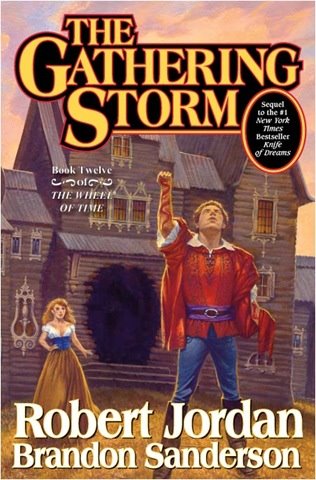
The Wheel of Time: The Gathering Storm

I never quite know what to answer when people ask me if I like the Wheel of Time books. I think I like the idea of them, the promise, the setting, more than the books themselves. The concept more than the execution, perhaps. But that concept is so good that I believe the books are worth reading on its singular merit. I maintain that a drastically shortened Wheel of Time, truncated after the third book, and fudged a bit in the last few chapters of the second and third books, could be the greatest fantasy trilogy ever written, The Lord of the Rings included.

But like all great series apparently must, the Wheel of Time dragged a bit--rather, a lot--in its middle. Where the first three books were brilliant, books four through seven were overly complicated but still interesting, and eight through eleven just plain dragged on, with perhaps only one important plot point happening in each. We fans were getting antsy: Robert Jordan promised us that the series was going to end soon, but if the last book or books plodded along with the same lack of excitement as the most recent handful, we might be left with a series ending in a whimper rather than the bang we felt like we deserved.

Then, as if for the sole purpose of throwing everything we knew into chaos (as well as being a strange reflection on the events of the series itself), Robert Jordan passed away in September 2007. Fortunately, things worked out much more smoothly than they really had any right to: Mr. Jordan's family and associates quickly got their collective act together and installed a new author, Brandon Sanderson, who would ensure that we got some sort of resolution to the story we'd spent decades following.

So here we have it: the most highly-anticipated fantasy novel since... the last Wheel of Time book? No, that's not quite right. Knife of Dreams, The Gathering Storm's immediate predecessor, was another step down the same old Robert Jordan path, while Storm was a bold new step in the Brandon Sanderson direction. Knife was merely book #11; Storm is either book #12, or the first part of book #12, or the first volume in the finale trilogy, depending on how you want to think of it. Knife was the continuation of fifteen years' prior work, and Storm represents not only the beginning of the end, but a new voice trying to integrate itself into thousands of old pages.

For the first half of the book, that integration becomes a major motif. In that first half, Sanderson touches base with every one of the major characters. It represents Sanderson gaining his footing, setting himself up as the author, and testing his control of the plots and characters. (A notable exception is Elayne, who strangely does not get a single chapter in this book, and barely so much as a handful of mentions. Is this a tacit admission by Sanderson that he has no idea what to do with Elayne?)

Sanderson asserts his place as an author of a Wheel of Time book, and not a mere fantasy book, by hearkening back to the series' beginning. Emond's Field and the Two Rivers get name-dropped more than they have since the action was actually happening there a few books back, Baerlon even merits a quick mention, Min starts to become an important character in her own right, and Tam gets his first lines in ages. Perhaps this is a thematically important decision, giving a nod to the "everything starts where it ends" cyclical nature of the mythology. Maybe Sanderson knows that the early books were the most beloved by fans, and he's trying to get on the readers' good sides by emphasizing their importance. Or possibly it's not even a conscious choice: because the first few books were more memorable, their characters and settings have worked their way back in because Sanderson feels inherently more connected to and comfortable with them.

Aside from all this base-touching and identity-imprinting, nothing much happens in the first half of the book. It plays out like an extended news report--but (perhaps a bit cynically) that's nothing we're not used to from the Wheel of Time. However, things change quickly around the time Rand has his decisive encounter with Semirhage. It's an oddly written part of the book, seeming forced in all respects. Shaidar Haran has become more or less a walking deus ex machina for the bad guys--Sanderson needs to establish and explain some restriction on this thing's powers quickly, or else a multitude of plot holes will spring up any time someone wonders "why doesn't Shaidar Haran just do it?" And Rand channeling the True Power better have some explanation of its own--not to mention consequences. But even for its clumsy execution, this scene gets the action moving.

It doesn't stop, either. Plots that have persisted for the last three or four books now--the White Tower siege, Tuon's waiting to proclaim herself Empress, Aviendha's transition to being a Wise One, the fate of Verin, and Rand's escalating insanity, just to name a few--are finally resolved. Even Mat and Thom's long-impending assault on the Tower of Ghenjei now seems imminent. Sanderson's deliberate decision to have Rand balefire Elza Penfell in that Semirhage encounter is of course more than just a protagonist defeating an antagonist. It's understood in the narrative as further evidence that Rand is becoming dangerous and on the brink of insane. But I think it's also a promise by Sanderson that we're going to see antagonists defeated decisively from now on, and we're not going to see the introduction of a lot more minor characters. After four or so books of not a lot happening, all of this is welcome news to readers.

Sanderson's skill is not only apparent in making events happen. He's almost equally as skilled in parsing out the story when things don't happen. Sanderson has a good sense of how to organize the story in terms of exciting scenes and developing scenes--he doesn't try to string together too much development at once with the same characters, which would get boring fast. But when it gets exciting, he lets us follow the action with the same set of people for several consecutive chapters without breaking up pivotal events.

Another way Sanderson organizes his story well is in his understanding of which plot events to show, and which ones to let the reader assume has happened. Sanderson neatly accomplishes this through leveraging his characters' ta'veren powers, which is something that Jordan either never did, or didn't emphasize nearly as much as Sanderson. This device of letting Rand, Mat, and Perrin "see" each other works well to advance the plot without having to devote a chapter to each thing that happens with all of them. For example, at one point, Mat travels to Caemlyn to get information. Rather than having to write an entire chapter about Mat, he lets Rand have a ta'veren vision of Mat. In about three lines, Sanderson accomplishes something that might have taken Jordan an entire chapter.

And that brings us to the elephant in the room: what if Sanderson's implementation of the Wheel of Time turns out better than Jordan's? Are fans going to see what Sanderson has done with the series and rush out to proclaim him its savior? Even if they do--and judging from how good The Gathering Storm was, that might not be too much of an exaggeration--it's clear that Sanderson is not about to accept that mantle. In a gracious and classy foreword, Sanderson tells the readers in no uncertain terms that he's merely a facilitator at this point. He reminds us that the final three Wheel of Time books are Jordan's first and ours, the readers', second.

Even if Sanderson manages a complete turnaround, the important thing to remember is that that's the very best Sanderson can hope for: a return to form. Although the words of the last three books might be Sanderson's, the stories themselves are not. Everything good about the Wheel of Time--and yes, there is a lot of it, in spite of the direction that last handful of books took--is a direct result of Robert Jordan's fantastic brilliance.

But in the end, Sanderson does accomplish that return to form, and he does it so convincingly that I'm excited about the next Wheel of Time book for the first time in years.


Currently listening: "Perfect Symmetry", Keane